

On this page
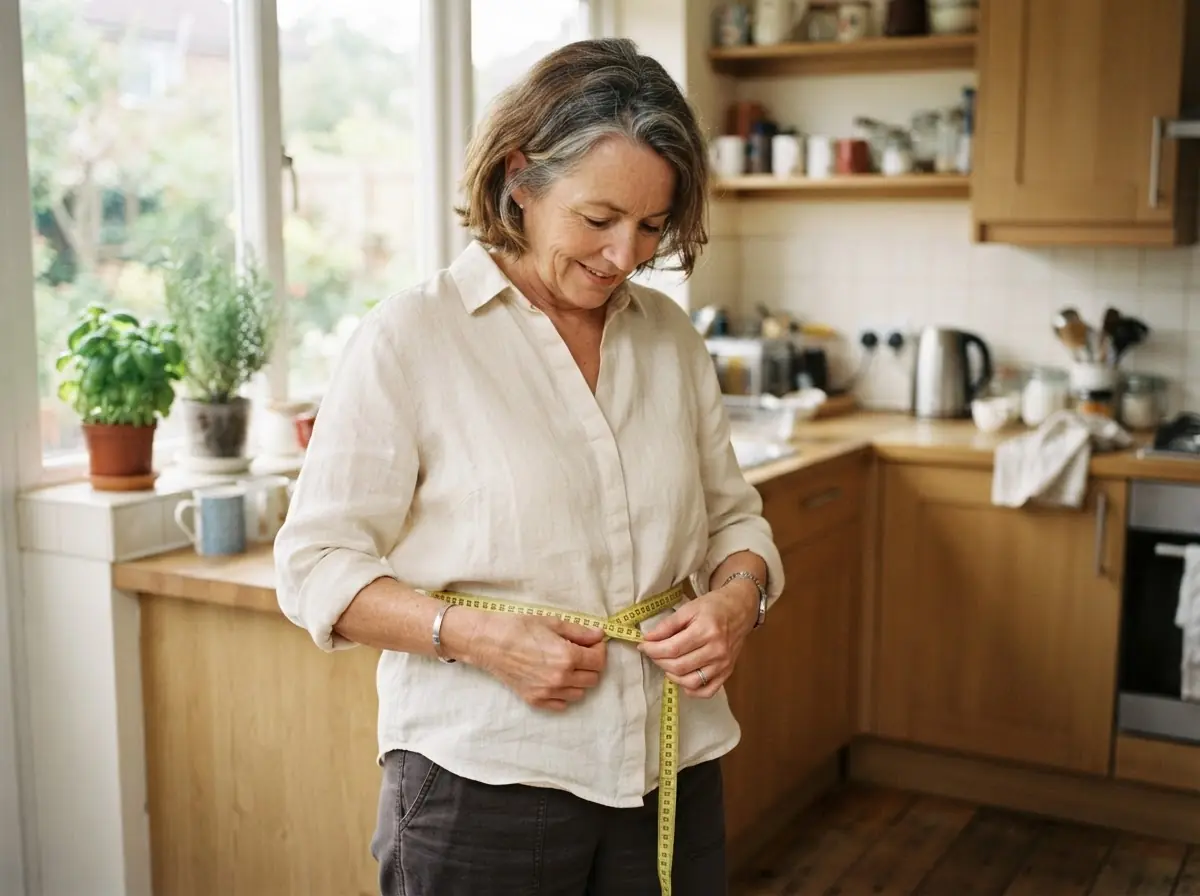
In short, at menopause your body can undergo many changes even though the scale shows little or no difference; fat, in particular, increases, especially around the waist, while muscle slowly decreases, the two effects canceling each other out on the scale. However, when you begin doing strength training the opposite occurs: you lose fat, build up muscle, and the weight still doesn’t change. It’s the size of your waist, your strength and the way your clothes fit that tell you much more.
What the scale can’t see
The SWAN (Study of Women’s Health Across the Nation) followed midlife women through to menopause using DEXA body scans. When the menopause transition began, the rate at which fat increased doubled and the amount of lean mass started to decrease, though the rate of weight gain did not change (Greendale et al., JCI Insight 2019).
The SWAN team stated clearly that body weight by itself doesn’t indicate what is going on beneath the skin, and that these changes may be the reason why BMI becomes a weaker predictor of health risk in older women (SWAN summary).
Therefore, if you have the same weight as when you were 45 but now feel softer, weaker and thicker in the middle, then your body isn’t deceiving you: the scale is merely measuring the wrong thing.
Where the fat goes
It’s not just the amount of fat that changes but its location. A further SWAN analysis examined 380 women over a median period of almost 12 years. In the reference group, visceral fat—which is the fat surrounding the organs—started to increase at the time of the menopause transition by about 6% per year and then kept rising more slowly, at about 1.5% per year (Greendale et al., JCEM 2021).
This is relevant to health; an analysis carried out by the University of Pittsburgh on SWAN data showed that women who experienced a quicker increase in abdominal fat during menopause had thicker carotid artery walls, an early sign of heart disease, independent of their overall weight (University of Pittsburgh, 2021).
Why lifting can make the scale stall
This is the reason why women give up too soon. A meta-analysis of 58 studies showed that resistance training alone, without any dietary changes, led to a reduction in body fat of about 1.5 percentage points, a decrease in fat mass of about half a kilogram, and a reduction in visceral fat when compared with no exercise; the effect was the same in women and men (Wewege et al., 2022).
On the other hand, a separate meta-analysis involving adults aged 50 and over showed that beginners gained approximately 1.1 kg of lean mass over a period of about five months (Peterson et al., 2011). When you compare these two findings, you end up with a woman who has lost some fat, gained muscle and altered her shape, yet the scale has changed only slightly. This is a success, not a standstill.
1.5%
reduction in body fat from resistance training
Wewege et al., 2022
~0.5 kg
fat mass lost, with no dietary changes
Wewege et al., 2022
1.1 kg
lean mass gained by beginners over five months
Peterson et al., 2011
When the scale drops fast, it’s worth asking what you lost.
The other trap is just as important. In a study involving 160 adults aged over 65 who had obesity and were losing weight, the ones who had only done aerobic exercise lost more lean mass and more hip bone density than those who had also done weightlifting (Villareal et al., 2017, via AAFP). If you’re losing weight after the age of 50, the way to ensure that most of the weight loss is fat is by doing strength training.
Better things to measure
| Measure | How | What it tells you | How often |
|---|---|---|---|
| Waist-to-height ratio | Waist measurement divided by height, same units | Central fat, a better guide to health risk than weight alone | Every 4–6 weeks |
| Strength log | Weight or band and reps on your main lifts | Whether you’re gaining muscle and function | Every session |
| Five-rise chair test | Time five sit-to-stands, arms crossed | Leg strength; over 15 seconds flags low strength | Every 6 weeks |
| One pair of fitted trousers | Try them on, same time of day | Shape change the scale misses | Monthly |
| The scale (optional) | Same scale, same time, same conditions | Long-term trend only | Weekly at most |
The National Institute for Health and Care Excellence (NICE) recommends that your waist should be less than half of your height, that is, a ratio below 0.5; it considers a ratio from 0.4 to 0.49 as normal, one from 0.5 to 0.59 as indicating an increased risk and any ratio of 0.6 or above as being classified as high risk. NICE also advises interpreting BMI with caution in people who are 65 years of age and over (NICE NG246; summary).
A serious drawback is that the 2021 SWAN study showed waist and hip measurements are less sensitive to changes in fat distribution than a DEXA scan. A tape measure won’t pick up all the details. It remains free, private, and considerably more informative than your bathroom scale.
How I’d apply this: a 58-year-old who travels and doesn’t want fitness to be her job
She is 58 and has been doing strength training for eight weeks, having become stronger with each lift, yet is devastated since the scale has not changed. This is one of the most typical situations which leads women to give up. Here’s what I would do.
Start with a measurement on day one, before any alterations are made. Take measurements of the waist and height, note the time it takes to sit down in a five-rise chair, and use one pair of trousers that she has selected as her ‘test pair’. You can’t have an after without first having a before.
For the first 12 weeks put the scale in the cupboard. If she wants to use it, she should do so once a week at the same morning time on the same scale. It must never be a hotel scale or the morning following a travel day, since using different scales and disrupting the routine result in numbers that cannot be compared with those taken at home.
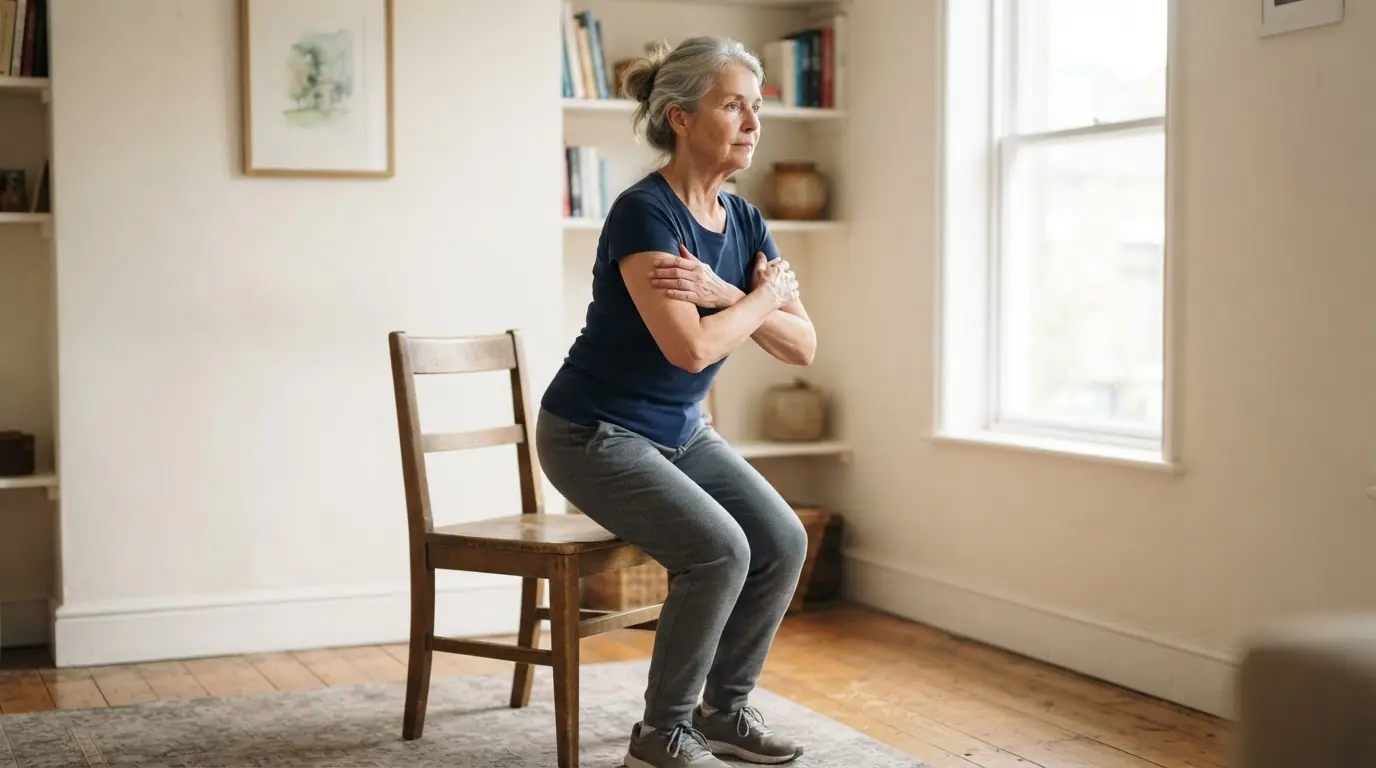
Make a check-in every six weeks not every morning, carry out the waist-to-height ratio test, take the chair test, keep a record of your strength and wear trousers. There are four signals and the duration is two minutes with no spiralling over a single number.
Say out loud that the stall has been reframed. In that case, if her weight remains the same but her lifts are increasing and her waist is decreasing, she is recomposing herself—that is, having less fat and more muscle. To show her, present the Wewege and Peterson figures together so that she can see that this is precisely what the research forecasts.
If a woman wants to lose weight, she should make changes to her diet rather than doing more exercise. Two sessions of strength training together with her walking are sufficient. The rest can be achieved by eating protein at each meal and making a small reduction in calories, while the strength training at the same time safeguards her muscle and bone.
Frequently asked questions
If my weight has not changed, why am I putting on tummy fat?
Why isn't the scale moving when I'm strength training?
What is the recommended waist-to-height ratio for women?
Will strength training help with the abdominal fat that occurs during menopause?
Will BMI be accurate for women over the age of 50?
Sources
- 1Ebell MH. Combination of resistance and aerobic exercise best for older persons with obesity. Am Fam Physician. 2017;96(5):331 (summarising Villareal DT et al. N Engl J Med. 2017;376(20):1943–1955). AAFP
- 2Greendale GA et al., ‘Changes in body composition and weight during the menopause transition’, JCI Insight, 2019;4(5):e124865. JCI Insight; SWAN summary
- 3Greendale GA et al. Changes in regional fat distribution and anthropometric measures across the menopause transition. J Clin Endocrinol Metab. 2021;106(9):2520–2534. PubMed
- 4National Institute for Health and Care Excellence. Overweight and obesity management (NG246): identifying and assessing overweight, obesity and central adiposity. NICE
- 5Peterson MD, Sen A, Gordon PM. Influence of resistance exercise on lean body mass in aging adults: a meta-analysis. Med Sci Sports Exerc. 2011;43(2):249–258. PubMed
- 6University of Pittsburgh. Accelerating gains in abdominal fat during menopause tied to heart disease risk, March 2021 (on a study in Menopause). Newswise
- 7Wewege MA et al. The effect of resistance training in healthy adults on body fat percentage, fat mass and visceral fat: a systematic review and meta-analysis. Sports Med. 2022;52(2):287–300. PubMed