

On this page
The simple reply is that being active does not mean being challenged. Although activities such as walking, gardening, yoga and pickleball are good for the heart, one’s mood and the joints, most of them never ask your muscles to work close to their limit. Once you reach fifty, strength declines more rapidly than muscle does, and power (which is strength produced quickly) fades away the fastest. It is only training that intentionally puts your muscles under challenge that can reliably reverse this trend.
“But I walk every day”
Okay, carry on doing so. Walking is good for both your heart and your mood, and in Canada, it counts as part of your 150 minutes of aerobic activity for the week.
However, it should be noted that the same guidelines treat muscle-strengthening as a separate recommendation: engaging in activities that target the major muscle groups at least twice a week (CSEP). This is so because muscles adapt to the demands placed upon them and then cease to adapt; the kind of exercise you usually do every day asks the same thing of your legs. After a few months it ceases to be a challenge and therefore does not result in any increase in strength.
Strength only continues to improve when the demand increases. The guideline from Osteoporosis Canada states that this should be achieved by increasing the number of sets, repetitions, weight, or difficulty over time (Morin et al., CMAJ 2023).
Strength fades faster than muscle.
The usual view is that people feel their strength is decreasing because they are losing muscle—this is only one part of the story.
The Health, Aging and Body Composition Study looked at muscle mass and strength in 1,880 older people over a period of three years and found that strength decreased much more rapidly than muscle mass. Those individuals who either maintained or actually gained some muscle mass still experienced a loss of strength (Goodpaster et al., 2006). The researchers therefore concluded that muscle quality—that is, the amount of force that each part of the muscle can generate—also declines.
This is why the European Working Group on Sarcopenia has now adopted low muscle strength rather than low muscle mass as the primary indicator of sarcopenia, which is the age-related loss of muscle function (Cruz-Jentoft et al., 2019).
Power fades fastest of all.
Power is strength applied rapidly; it’s the kind that enables you to spring up from a low chair at once, get up the stairs before the light changes, and regain your feet when your toe hits the curb.
Muscle power decreases earlier and more sharply with age than strength, and low levels of muscle strongly predict whether older adults will have difficulty with everyday tasks (Reid & Fielding, 2012). Gentle and slow activity is of very little help in developing it.
In addition to all this, the menopause transition causes a faster loss of lean tissue in many women.
Can Women Over 50 Still Build Muscle?A two-minute self-check
Sit in a normal dining chair with your arms folded over your chest and time how long it takes you to stand up completely and then sit down five times, as quickly as you can do so safely.
Try the test yourself
Sit in a chair, fold your arms across your chest, then stand up and sit back down five times as quickly as you safely can. Tap Count this stand each time you sit back down — the timer stops at five.
The European Sarcopenia Group considers a time of more than 15 seconds when performing five rises as an indicator of low strength and also employs a grip strength below 16 kg for women, a value that can be measured by a physiotherapist or doctor using a handheld dynamometer (EWGSOP2 cut-offs).
They are screening thresholds, not a diagnosis; if your result is slow, then you should begin training and tell your doctor about it, while if it is fast then that becomes your baseline to beat.
>15s
five chair rises suggests low strength
European Sarcopenia Group (EWGSOP2)
16 kg
grip strength cut-off for women
EWGSOP2 cut-offs
2×
strength training twice each week
CSEP 24-Hour Movement Guidelines
When weakness needs a doctor first
Weakness that develops slowly over a number of years is generally due to training and aging; however, you should have yourself checked if the weakness has appeared suddenly over a period of weeks, if it affects one side more than the other, or if it is accompanied by unexplained weight loss, pain, numbness or exhaustion.
If the weakness is sudden and affects only one side of the body, particularly when it is accompanied by a drooping face or slurred speech, you should call 9-1-1. These are the FAST signs of a stroke (BCMJ / Heart & Stroke).
What turns it around
- 1Doing strength training twice each week using weights that are heavy enough that the final few repetitions are actually difficult.
- 2Some power exercises. The position statement issued by the NSCA concerning older adults suggests that power exercises should be included and carried out at a faster speed (Fragala et al., 2019). A meta-analysis published in 2022 of 15 trials showed that power training increased muscle power and performance on everyday functional tests in older adults to a greater extent than conventional strength training did (el Hadouchi et al., 2022).
- 3It’s important to carry out practice, since strength and power only prove useful if your body can apply them at the right time.
- 4Keep on going; strength training contributes to your level of activity and does not take its place.
How I’d apply this: a 58-year-old who travels and doesn’t want fitness to be her job
Imagine her: she is 58, walks most days, takes a yoga class when at home, and travels every few weeks. She is confused that suitcases and stairs now seem harder than they used to. That is what I would do.
Stick with all the things she currently does; her walking and yoga will remain. I am not substituting her present activities; rather, I am adding the one element that is missing.
Include two brief strength workouts each week—30 minutes worth, consisting of six exercises, either at home or in the hotel room using two resistance bands. That kind of stimulation her daily life never gives.
Choose one exercise to be a strength exercise. When doing sit-ups, go ‘quickly up, slowly down’—stand up as swiftly as she can do so safely and then take three seconds to sit back down. Perform three sets of eight. No equipment is needed and the exercise can be carried out in any hotel room, since it develops exactly the ability that she is losing most rapidly.
Check every six weeks; the five-stage chair test lasts two minutes and turns a vague sense—“I think I’m stronger?”—into a figure which she can watch decrease.
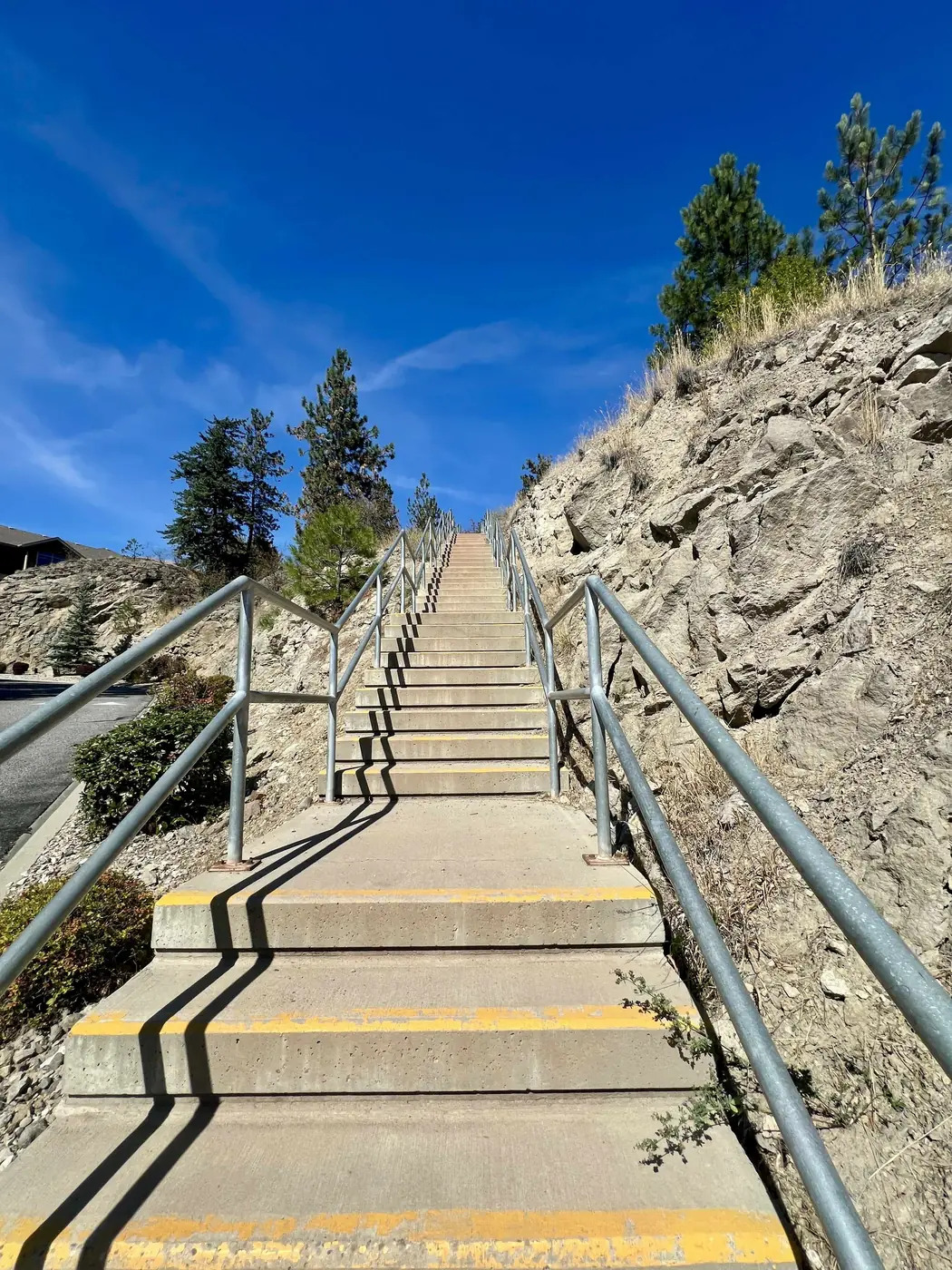
Make use of the trip. On days when she is travelling, she climbs the stairs at the airport or hotel, taking one floor at a time in a brisk manner and brings her own bag with her. Although it isn’t a workout, it helps to keep the power habit going between the sessions.
Frequently asked questions
Will walking provide adequate exercise after the age of 50?
Is it normal for strength to decrease as part of ageing?
Why do my legs feel weak on the stairs?
Does yoga increase strength?
What is sarcopenia?
Sources
- 1British Columbia Medical Journal. Look for FAST signs of a stroke. BCMJ. 2015;57(6):255. bcmj.org
- 2Canadian Society for Exercise Physiology. Adults 65+. 24-Hour Movement Guidelines. csepguidelines.ca
- 3Cruz-Jentoft AJ et al. Sarcopenia: revised European consensus on definition and diagnosis. Age Ageing. 2019;48(1):16–31. Open access; the cut-off points are summarised in the PMC table
- 4el Hadouchi M and others. Effectiveness of power training compared to strength training in older adults: a systematic review and meta-analysis. European Review of Aging and Physical Activity. 2022;19:18. PMC
- 5Fragala MS and others. Resistance training for older adults: position statement from the National Strength and Conditioning Association. Journal of Strength and Conditioning Research. 2019;33(8):2019–2052. Journal
- 6Goodpaster BH et al., The loss of skeletal muscle strength, mass, and quality in older adults: the Health, Aging and Body Composition Study, J Gerontol A Biol Sci Med Sci, 2006;61(10):1059–1064. PubMed
- 7Morin SN and others. Clinical practice guideline for management of osteoporosis and fracture prevention in Canada: 2023 update. CMAJ. 2023;195(39):E1333–E1348. CMAJ
- 8Reid KF and Fielding RA. Skeletal muscle power: a critical determinant of physical functioning in older adults. Exerc Sport Sci Rev. 2012;40(1):4–12. PMC