

On this page
- Why bother starting now?
- Step 1: Do a five-minute health check
- Step 2: Train twice a week
- Step 3: Learn six movements
- Step 4: Choose a weight that's heavy enough
- Step 5: Add a little, then keep going for a year
- Step 6: Later on, add a little speed
- Do I need a gym?
- How I'd apply this: a 58-year-old who travels and doesn't want fitness to be her job
- Frequently asked questions
- Sources
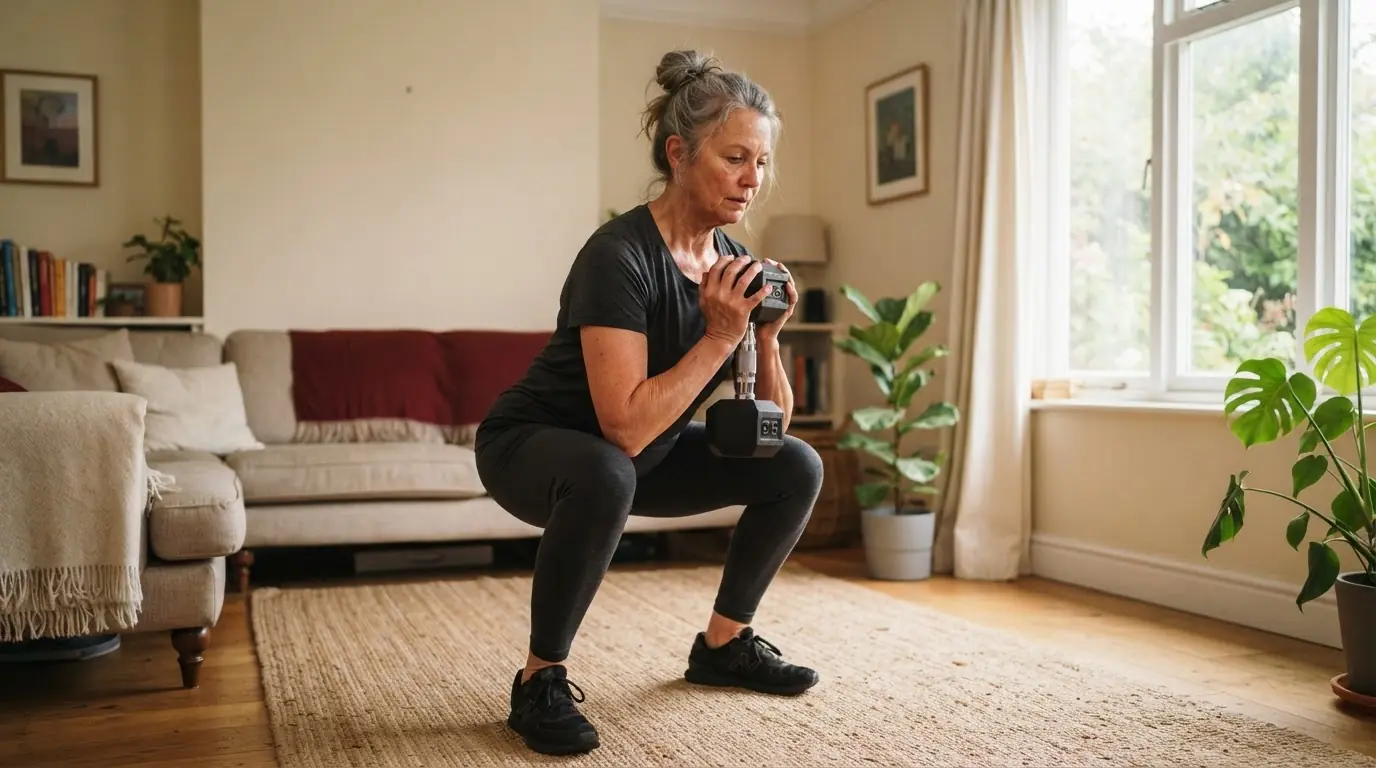
To get started, aim for two full-body strength sessions each week, about 30 minutes each. Focus on six key exercises: squat, hip hinge, push, pull, carry, and a balance move. Pick a weight that feels challenging but lets you finish each set with two or three good reps left. Try to increase the weight a bit each week. This matches the advice from Canada's movement guidelines and the National Strength and Conditioning Association, and it's often less than most women expect.
Why bother starting now?
Since the majority of us aren't carrying out this recommendation, just 35 per cent of adult Canadians meet the muscle-strengthening guideline, as stated in ParticipACTION's 2025 Report Card.
Even a small time commitment brings big benefits. A 2022 meta-analysis in the British Journal of Sports Medicine looked at 16 studies and found that doing 30 to 60 minutes of muscle-strengthening exercise each week was linked to a 10 to 20% lower risk of dying from any cause, including heart disease and cancer (Momma et al., 2022). These studies show a connection, not direct cause and effect, but just an hour a week is a simple way to get these benefits.
35%
of adult Canadians meet the muscle-strengthening guideline
ParticipACTION 2025 Report Card
10–20%
lower risk of dying from any cause
British Journal of Sports Medicine, 2022
2×
full-body strength sessions each week
Canada's 24-Hour Movement Guidelines
The main reason is independence, like being able to get up from the floor, carry your own suitcase, or open a jar.
What Does "Aging Well" Actually Mean for Strength and Independence?Step 1: Do a five-minute health check
Before you begin, complete the PAR-Q+, which is a free screening questionnaire from Canada. HealthLink BC refers to it as a form that you administer yourself before starting a new programme. You may proceed if you say 'no' to all seven of the first questions, provided that you start slowly and gradually increase your activity (HealthLink BC). If you answer 'yes' then you will be directed to a more detailed online questionnaire or you will need to have a conversation with your doctor.
The fact that you have osteoporosis or low bone density is generally one of the reasons why you should train carefully and not why you should omit training. According to Osteoporosis Canada's 2023 guidelines, progressive resistance training should be done at least twice a week and balance and functional training should also be carried out at least twice a week in order to reduce the risk of falling (Morin et al., CMAJ 2023).
Step 2: Train twice a week
Canada's 24-Hour Movement Guidelines recommend muscle-strengthening activities at least twice a week for adults of all ages (CSEP, adults 65+).
The findings regarding older adults are consistent with those of the study. A meta-analysis of 25 randomised trials involving healthy adults aged 60 and above showed that the greatest gains in strength were achieved with two sessions each week, two to three sets per exercise and seven to nine repetitions per set (Borde et al., 2015). The position statement issued by the NSCA suggests two to three sessions per week (Fragala et al., 2019).
You don't have to work out every day. Two sessions a week are enough to make a difference, and three is fine if you enjoy it.
Step 3: Learn six movements
You don't need a long list of exercises. What matters is practicing the main movement patterns your body uses daily.
| Movement | What it trains in real life | Beginner version | Gym version | Travel version |
|---|---|---|---|---|
| Squat | Getting up from a chair or the toilet | Sit-to-stand from a chair | Goblet squat with a dumbbell | Sit-to-stand from the hotel bed, holding your backpack |
| Hip hinge | Picking things up without hurting your back | Hands-on-hips bow to a wall behind you | Dumbbell Romanian deadlift | Band good morning |
| Push | Getting up off the floor, pushing a heavy door | Wall push-up | Dumbbell chest press | Push-up with hands on the hotel desk |
| Pull | Lifting a suitcase into the overhead bin | Band row, band looped around a post | Seated cable row | Band row anchored in the door |
| Carry | Groceries, grandchildren, luggage | Carry two shopping bags for 30 seconds | Farmer's carry with dumbbells | Suitcase carry, one side at a time |
| Balance | Not falling on a curb or icy step | Stand on one leg, hand on the counter | Step-ups onto a low box | Single-leg stand while brushing your teeth |
Squat
- What it trains in real life
- Getting up from a chair or the toilet
- Beginner version
- Sit-to-stand from a chair
- Gym version
- Goblet squat with a dumbbell
- Travel version
- Sit-to-stand from the hotel bed, holding your backpack
Hip hinge
- What it trains in real life
- Picking things up without hurting your back
- Beginner version
- Hands-on-hips bow to a wall behind you
- Gym version
- Dumbbell Romanian deadlift
- Travel version
- Band good morning
Push
- What it trains in real life
- Getting up off the floor, pushing a heavy door
- Beginner version
- Wall push-up
- Gym version
- Dumbbell chest press
- Travel version
- Push-up with hands on the hotel desk
Pull
- What it trains in real life
- Lifting a suitcase into the overhead bin
- Beginner version
- Band row, band looped around a post
- Gym version
- Seated cable row
- Travel version
- Band row anchored in the door
Carry
- What it trains in real life
- Groceries, grandchildren, luggage
- Beginner version
- Carry two shopping bags for 30 seconds
- Gym version
- Farmer's carry with dumbbells
- Travel version
- Suitcase carry, one side at a time
Balance
- What it trains in real life
- Not falling on a curb or icy step
- Beginner version
- Stand on one leg, hand on the counter
- Gym version
- Step-ups onto a low box
- Travel version
- Single-leg stand while brushing your teeth
Step 4: Choose a weight that's heavy enough
This is where many women go wrong—they often stick with weights that are too light for too long.
The NSCA recommends that beginners should do 10 to 15 repetitions with a lighter weight, afterwards progressing to 6 to 12 repetitions using heavier weights and eventually training at about 70 to 85% of the maximum weight that can be lifted in one repetition (Fragala et al., 2019); the Borde meta-analysis showed that the greatest strength gains occurred at 70 to 79% of one-rep maximum.
You don't have to test your maximum strength to use this approach. My coaching tip: by the end of each set, you should feel like you could do two or three more good reps, but not five. If you could easily do ten more, the weight is too light. Also, you don't need to push until you can't move the weight anymore. The NSCA says training to failure isn't needed for strength gains in older adults.
Step 5: Add a little, then keep going for a year
Make progress gradually. For each set, add a few reps until you reach the top of your target range. Then, move up to a slightly heavier weight or stronger band and start again from the lower end of your range.
Consistency matters most in the long run. The Borde analysis found that programs lasting about a year gave the best results, showing that sticking with it is more important than pushing for intensity.
Step 6: Later on, add a little speed
When the movements have become firm, the NSCA suggests adding power exercises, which involve lifting a moderate weight quickly during the upward phase while keeping control during the descent. For the majority of women this just amounts to rising quickly from a chair or pushing a resistance band out fast. Power decreases more rapidly with age than strength, which is the reason it's so important when you have to catch yourself on a trip.
Why Am I Getting Weaker Even Though I'm Active?Do I need a gym?
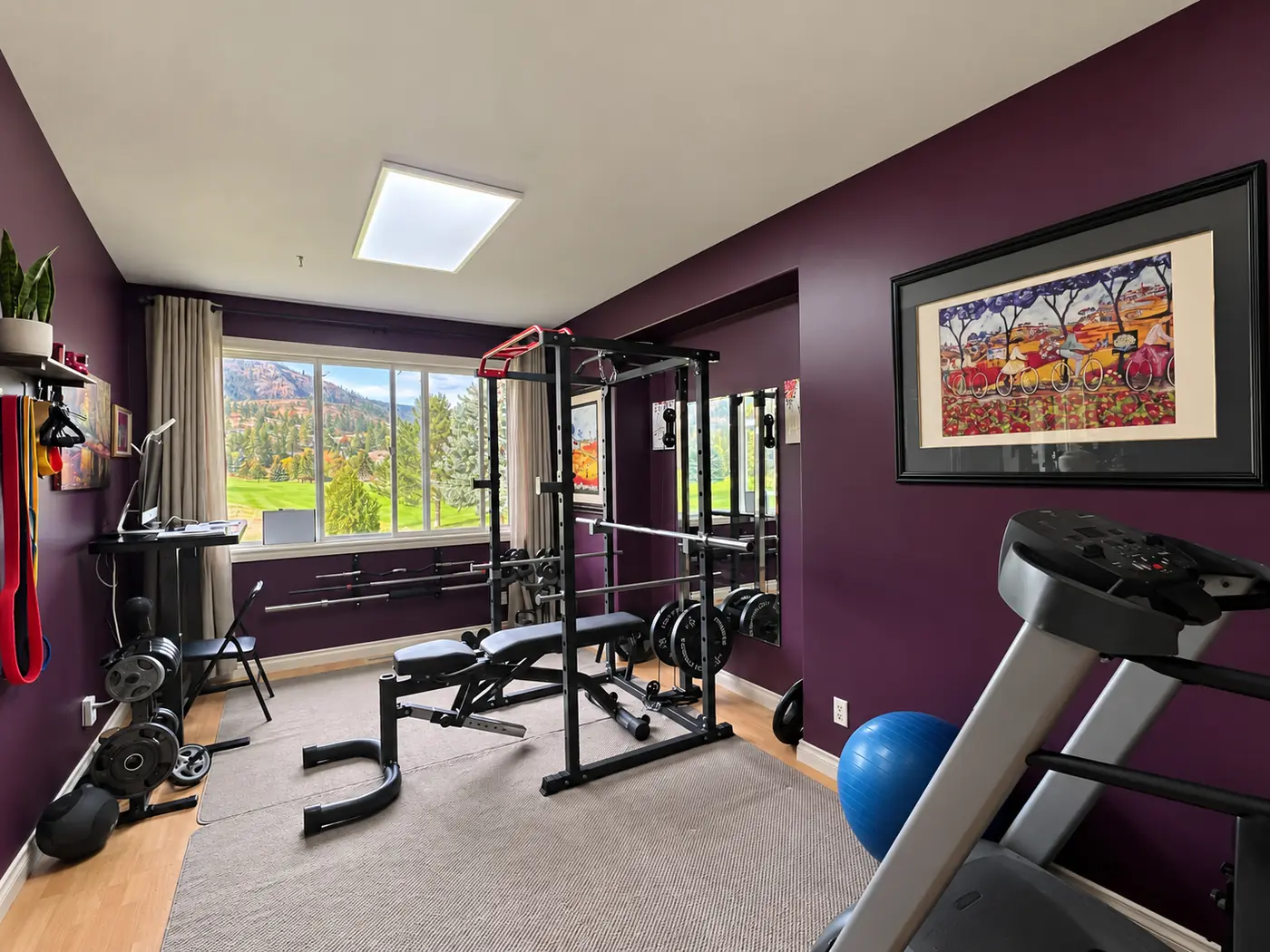
Not at all; a meta-analysis comparing elastic bands with weight machines and dumbbells found that the groups and programs produced similar strength gains (Lopes et al., 2019). In a gym you have more options for increasing the load as your strength increases. You can start with bands and bodyweight, and elastic bands are suitable for carrying in your hand luggage.

How I'd apply this: a 58-year-old who travels and doesn't want fitness to be her job
Picture a 58-year-old woman who has never stuck with weight training because she's often busy with work or family. She wants results without making the gym her whole life. Here's how I'd set things up for her.

She'll have two set sessions each week, doing the same six exercises every Tuesday and Friday for 30 minutes. These can be done at home or at the gym. For the first eight weeks, she repeats the same exercises each time, so there's nothing new to learn at each session. In this case, a little boredom is actually helpful because it makes the routine easy to stick with.
She needn't worry about having to think about a travel version. In her suitcase there are one loop band and one long band with handles, their weight being less than that of a pair of shoes. The six patterns used at the hotel are exactly the same as those in the table above, so traveling doesn't involve starting again.
If her week doesn't go as planned, she can follow this simple routine: three rounds of 10 sit-to-stands, 10 band rows, 8 desk push-ups, and 30 seconds of single-leg balance on each side. This keeps her on track and helps maintain the habit until her schedule returns to normal.
After each session, she notes the exercise, weight or band color, and number of reps on her phone. This helps her know when to increase the weight and reminds her she's getting stronger, even on days she doesn't feel it.
I wouldn't ask her to train every day, spend 90 minutes in the gym, chase muscle soreness, or buy any equipment besides two bands until she's been at it for six weeks.
Frequently asked questions
How frequently should a woman who is over 50 do weightlifting?
Has it gone too far to begin strength training when one is 60 or 70?
Will lifting weights make me bulky?
Is it safe for someone with osteoporosis to do strength training?
How long ought a strength session to last?
Sources
- 1Borde R, Hortobágyi T, Granacher U. Dose–response relationships of resistance training in healthy old adults: a systematic review and meta-analysis. Sports Med. 2015;45(12):1693–1720. PubMed
- 2Canadian Society for Exercise Physiology. Adults 65+ – 24-Hour Movement Guidelines. csepguidelines.ca
- 3Fragala MS et al., 'Resistance training for older adults: position statement from the National Strength and Conditioning Association', Journal of Strength and Conditioning Research, 2019;33(8):2019–2052. Journal
- 4HealthLink BC, PAR-Q+ and ePARmed-X+, at healthlinkbc.ca
- 5Lopes JSS and others. Effects of training with elastic resistance versus conventional resistance training on muscular strength: a systematic review and meta-analysis. SAGE Open Med. 2019;7:2050312119831116. PubMed
- 6Momma H, Kawakami R, Honda T, Sawada SS. Muscle-strengthening activities are associated with lower risk and mortality in major non-communicable diseases: a systematic review and meta-analysis of cohort studies. Br J Sports Med. 2022;56(13):755–763. PMC
- 7Morin SN and others. Clinical practice guideline for management of osteoporosis and fracture prevention in Canada: 2023 update. CMAJ. 2023;195(39):E1333–E1348. CMAJ
- 8ParticipACTION. 2025 ParticipACTION Report Card on Physical Activity for Adults: Moving Beyond Stagnation: Elevating Physical Activity in Canada. www.participaction.com