


On this page
- What the guidelines say
- What cardio gives you that strength training can't
- What strength training gives you that cardio can't
- What happens when you do both
- Can cardio undo the strength gains I've made?
- How I'd apply this: a 58-year-old who travels and doesn't want fitness to be her job
- Frequently asked questions
- Sources
In short, yes, you do need to do both. Cardiorespiratory exercise helps to protect your heart and lungs, while strength training helps to protect your muscles, bones, and your ability to look after yourself. The best outcomes from large-scale studies are achieved by combining both types of exercise. The guidelines issued by Canada suggest that you should do at least 150 minutes of moderate-to-vigorous aerobic activity each week together with strength training at least twice a week, and also include balance exercises if you are 65 years of age or older.
What the guidelines say
| Guideline | Aerobic activity | Strength training | Balance |
|---|---|---|---|
| Canada, adults 18–64 (CSEP) | At least 150 min/week, moderate to vigorous | At least twice a week, major muscle groups | Not specified |
| Canada, adults 65+ (CSEP) | At least 150 min/week, moderate to vigorous | At least twice a week, major muscle groups | Activities that challenge balance |
| World Health Organization, older adults | 150–300 min/week moderate, or 75–150 min vigorous | 2 or more days a week | Varied balance-and-strength activity on 3 or more days a week |
If the figures seem remote, CSEP makes it clear that making progress towards any of the targets results in some health benefit (CSEP guideline PDF).
What cardio gives you that strength training can't
The ability of your heart, lungs and muscles to use oxygen—known as cardiorespiratory fitness—is one of the best indicators of both the length and quality of your life. A meta-analysis published in JAMA, which included 33 studies and nearly 103,000 people, showed that for every 1-MET rise in fitness there was a 13 per cent reduced risk of dying from any cause and a 15 per cent lower risk of suffering a heart disease event (Kodama et al., 2009). One MET is about the difference between jogging at 8 km/h and at 9 km/h.
Strength training is also good for the heart, but it cannot build up your aerobic capacity the way that brisk walking, cycling, swimming or hiking can.
What strength training gives you that cardio can't
Strength, muscle and bone – the most clear-cut example is found in a study published in The New England Journal of Medicine. In this study, 160 adults aged 65 and over who were obese were placed on a weight-loss program along with either aerobic training, resistance training, or both. Strength increased more in the two groups that did weightlifting. These groups also lost less lean mass and less hip bone density when losing weight than the group that received only aerobic training (Villareal et al., 2017, as summarised in American Family Physician; trial summary).
After the age of 50 it is very important not to lose weight solely through cardio, since this can result in losing muscle and bone which you cannot easily afford to lose.
What happens when you do both
The identical trial published in the NEJM showed that the group receiving both types of training improved the most in their assessment of everyday physical performance—by 21%, as opposed to 14% for those who did either aerobic or resistance training alone. However, there is one point to be made honestly: the group that combined the two types of exercise also spent more minutes per week exercising, a factor which probably played a role.
Large population studies all come to the same conclusion. A study published in the British Journal of Sports Medicine in 2026 kept track of 147,374 individuals, of whom 115,834 were women with an average initial age of 54, for up to 30 years. Those who carried out between 90 and 119 minutes of strength training each week had a 13 per cent reduced risk of dying. Engaging in aerobic exercise in excess of the recommended amount was associated with a 26 to 43 per cent lower risk. When strength training was added, the risk was reduced even more at almost all levels of aerobic activity: people who did four to six times the minimum amount of aerobic exercise prescribed plus one to two hours of strength training per week had a 45 per cent lower risk than those with under 7.5 MET-hours a week of aerobic activity and no strength training. However, at very high volumes of aerobic activity the additional benefit of strength training ceased to be measurable (BMJ Group press release; study). Since this is observational data, it only shows an association and not proof, but it is consistent with all the other information we have.
Can cardio undo the strength gains I've made?
The study involving older adults did not find any difference. In the NEJM trial, the group that carried out both types of exercise gained strength to a similar extent to that of the group which did only resistance training, and the researchers found that the two types of exercise did not interfere with each other (AAFP). The NSCA suggests that when both types of exercise are carried out in the same session, strength training should be done first (Fragala et al., 2019).
How I'd apply this: a 58-year-old who travels and doesn't want fitness to be her job
The person is 58, has only recently started strength training, travels every few weeks, and has no intention of spending her entire life in a gym. The following week achieves both of these objectives in a total time of about three and a half hours.
| Day | What she does | Time |
|---|---|---|
| Monday | Strength session (six movements) | 30 min |
| Tuesday | Brisk walk | 30 min |
| Wednesday | Brisk walk, bike or swim | 30 min |
| Thursday | Strength session | 30 min |
| Friday | Brisk walk | 30 min |
| Saturday | Longer walk, hike or bike ride | 60 min |
| Sunday | Rest or an easy stroll | – |
That amounts to 60 minutes of strength training and 150 minutes of aerobic exercise. Brisk means breathing more rapidly yet still being able to talk.
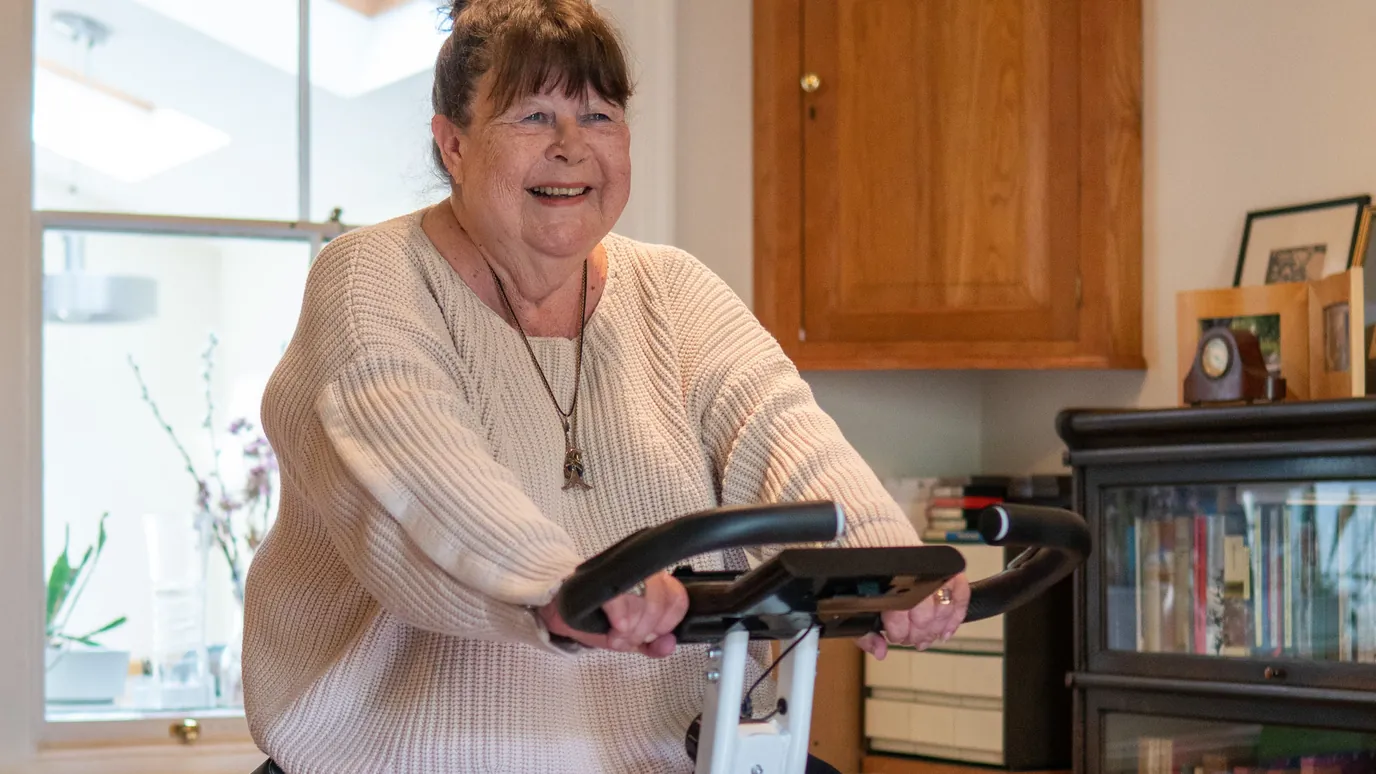
Cardio is looked after while you're on the road; walking around a new city usually takes her 150 minutes. Strength is what she loses when she's travelling, which is why I'll make sure to keep two 30-minute sessions in the hotel room with bands, the same six movements as when she's at home.
When she's short of time, strength comes out on top. If a busy week allows her only the time for two sessions of any kind, then I'd have her do the two strength sessions and go for walks whenever she can. Most people manage to walk. It is very rare that someone accidentally lifts something heavy.
If she's starting with no habits, she should build them one at a time. After four weeks of doing two strength sessions, the walks should then be added. Trying to change everything in the first week is the quickest way of ending up with nothing by the fourth week.
- 1Build one habit at a time. Start with two strength sessions; add the walks after four weeks.
- 2Do strength first on combined days. The NSCA recommends this order so you're fresh for the lifts that protect muscle and bone.
- 3Protect strength while travelling. Hotel-room band sessions keep the part that's hardest to maintain on the road.
Frequently asked questions
Which is better for women over fifty, cardio or strength training?
How many days a week should I have strength training and cardio?
What's better for weight loss after 50, cardio or strength training?
Can I do cardio and strength training on the same day?
Will walking provide sufficient cardio?
Sources
- 1BMJ Group. 90-120 weekly minutes of strength training may be optimal for lowering death risk. Press release, 2 June 2026, on a study in Br J Sports Med, doi:10.1136/bjsports-2025-110503. BMJ Group
- 2Bull FC and others, World Health Organization 2020 guidelines on physical activity and sedentary behaviour. Br J Sports Med. 2020;54(24):1451–1462. Record
- 3Canadian Society for Exercise Physiology. Canadian 24-Hour Movement Guidelines for Adults aged 18-64 years and Adults aged 65 years or older. 18 to 64; 65 and over
- 4Ebell MH. Combination of resistance and aerobic exercise best for older persons with obesity. Am Fam Physician. 2017;96(5):331 (this summary is of Villareal DT et al. N Engl J Med. 2017;376(20):1943–1955). AAFP
- 5Fragala MS et al., 'Resistance training for older adults: position statement from the National Strength and Conditioning Association', Journal of Strength and Conditioning Research, 2019; 33(8): 2019–2052. NSCA PDF
- 6Kodama S et al. Cardiorespiratory fitness as a quantitative predictor of all-cause mortality and cardiovascular events in healthy men and women: a meta-analysis. JAMA. 2009;301(19):2024–2035. Abstract